David Frederick Heatwole
David Frederick Heatwole is a prolific, award-winning artist based in Berea, Ohio, whose creative practice spans painting, drawing, photography, sculpture, and mixed media. An 11th-generation artisan, Heatwole grew up in Virginia at the elbow of his father, noted sculptor John L. Heatwole, surrounded by the tools, stories, and traditions of a family of makers stretching back centuries. A few years ago, life brought him to Ohio—the place where his beloved bride was raised—and where he continues creating today.
Rather than settling into a single style, Heatwole works “like a hummingbird,” moving between several ongoing bodies of work as inspiration, ideas, and discoveries lead him from one to another. His diverse series explore perception, energy, symbolism, transformation, human connection, and the often-unseen patterns that link our experiences.
For Heatwole, creating art is as much about discovery as making an object. Whether returning to a series after days or years, he continually builds upon an evolving visual conversation—inviting others to look closer, question what they see, and rediscover the power of curiosity, creativity, wonder, and amazement.
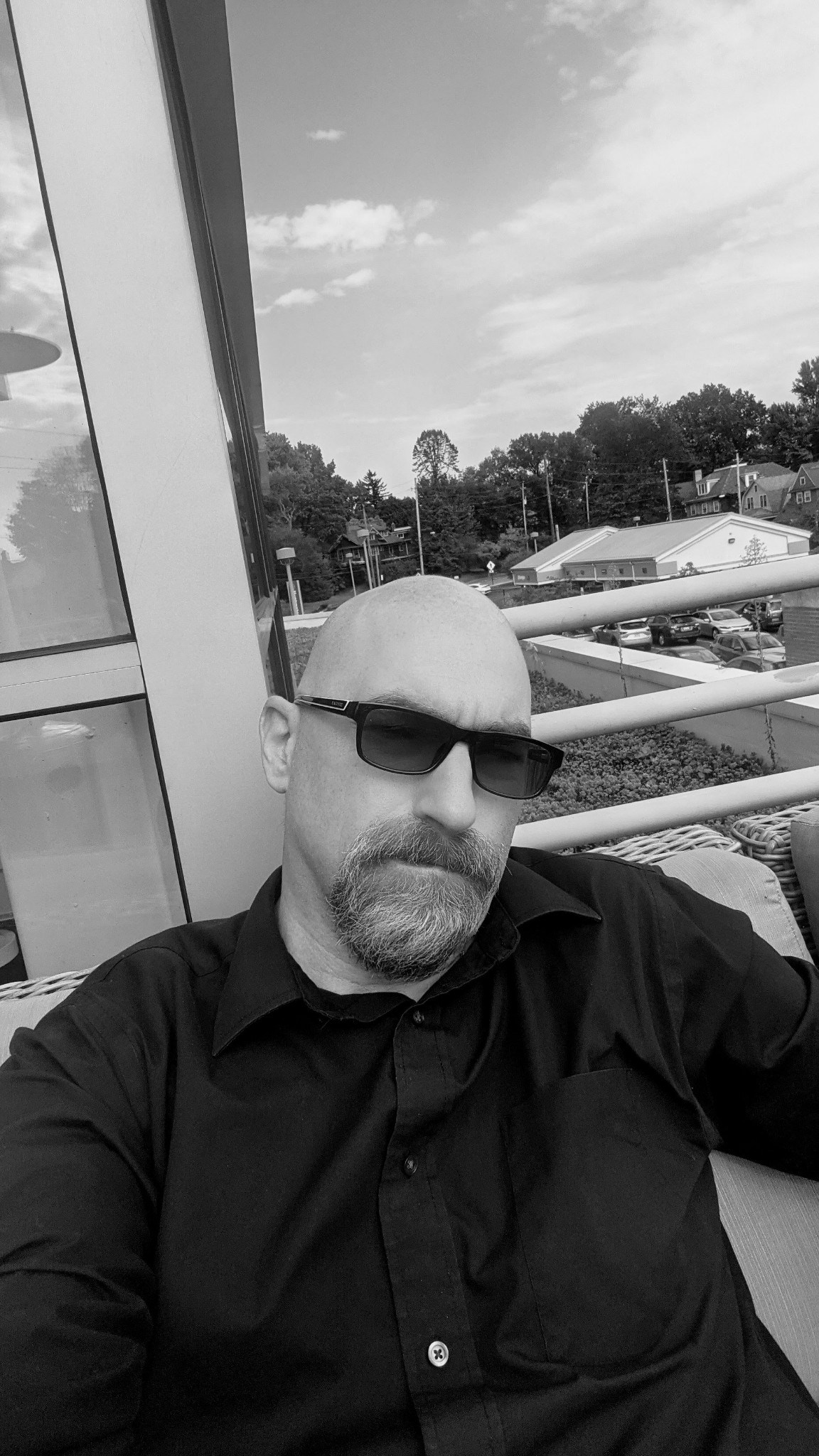
2020 — a much older David F. Heatwole.
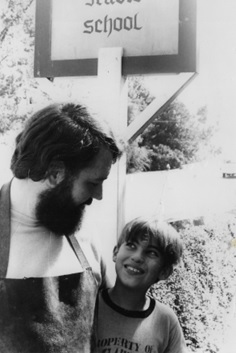
1983 — a young David with his father, John L. Heatwole III.
Shifting Planes
Artist Statement
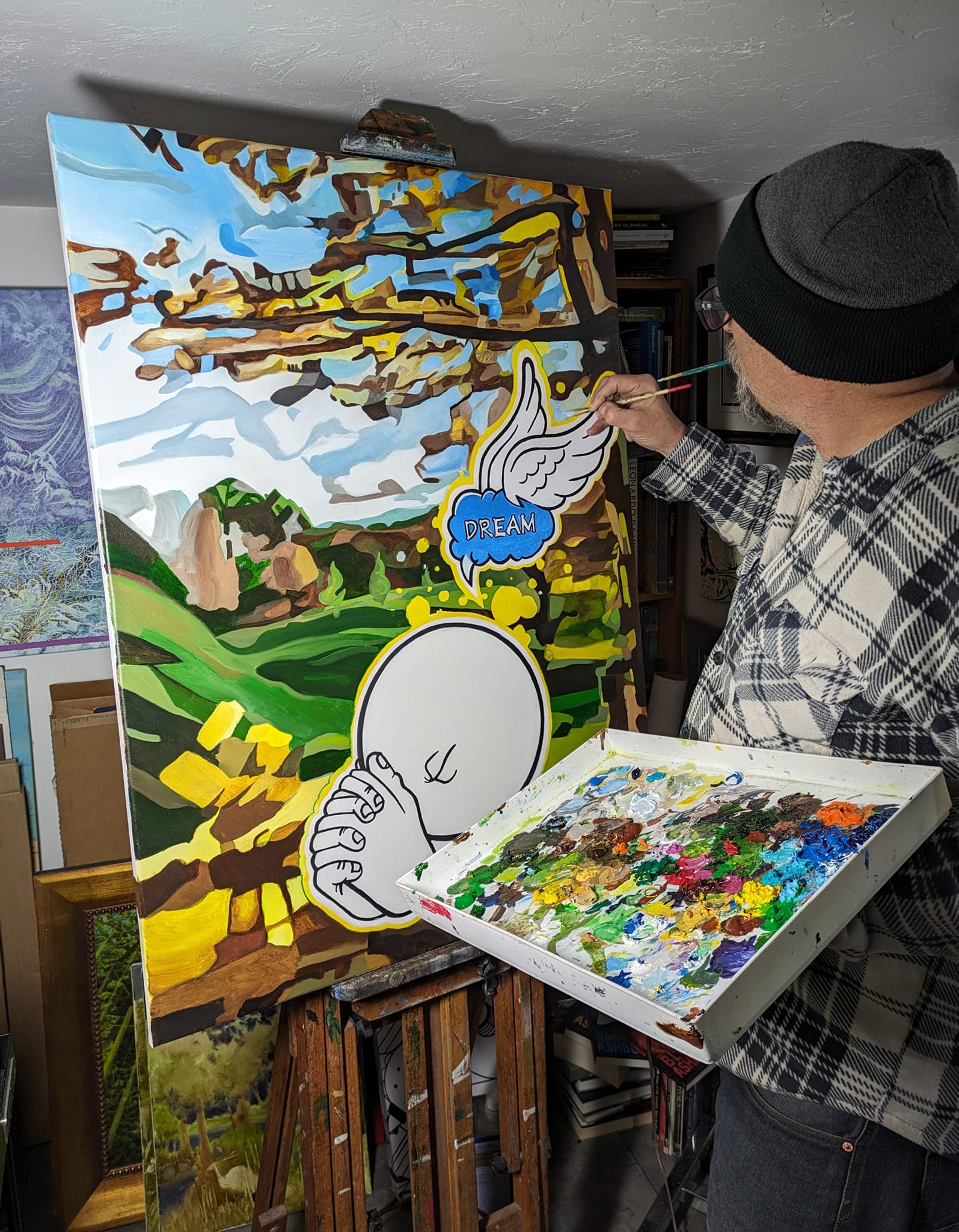
The Shifting Planes series began around 2015, but its origins reach back through more than a decade of friendships, artistic exchanges, and shared ideas.
One important influence was my friend and one-time studio mate Karl Scofield. I first met Karl in 2002 at a gallery and frame shop in Frederick, Maryland, where he worked as a framer. His work immediately resonated with me. We both experimented with dripped and poured house paint enhanced with other media, yet Karl also had another painterly language—fields and shapes of color that sometimes reminded me of stained glass and at other times of fragmented Impressionism.
Years later, one of those paintings hung beside my drafting table. One day, while looking at it, I began experimenting with fields of color in a similar spirit as backgrounds for drawings I had previously created under the name David Johnson. Those drawings had existed only as ideas in my sketchbooks. Suddenly, they had somewhere to go.
Another influence was artist Yuriy Karabash, whom I met in 1997. Although his work was very different from Karl's, I began recognizing possibilities between their approaches—particularly movement, energy, fragmentation, and the interaction of shapes and color. Interestingly, I had brought their work together years earlier in United States of Energy, an exhibition I curated at the Delaplaine Arts Center in Frederick in 2003. More than a decade later, those visual conversations resurfaced in an unexpected way within my own work.
Karl eventually reentered my life after nearly ten years apart. He had moved to Martinsburg, West Virginia, practically becoming my neighbor, and was struggling to begin creating again. I invited him to work in the studio behind my home. Having an artist whose work I respected creating beside me renewed a dialogue about art, experimentation, persistence, and the exchange of creative energy.
From those experiences, Shifting Planes began developing a language of its own.
The series is primarily acrylic on canvas, although I have also explored it through oils, watercolor, and drawing. Solid fields of color collide with translucent passages, fractured forms, lines, and shapes that appear to shift, overlap, emerge, or disappear. There is something of stained glass in the structure, but I don't want the image to feel static. Some planes appear momentarily fixed while others seem to be moving through, behind, or beyond them.
At the heart of the series is a question that continues to fascinate me:
What if everything around us is in motion, and perception is simply the instant in which we arrest that movement long enough to comprehend it?
I sometimes imagine catching reality from the corner of my eye before conscious observation brings everything back into recognizable order. Perhaps for an instant the landscape, figure, flower, or object is not entirely solid, but a constantly changing arrangement of energy, information, color, and form.
My fascination with scientific experiments involving observation and measurement has only deepened this curiosity. I do not attempt to illustrate quantum physics literally. Rather, the strange relationship between observation and what can be observed provides a metaphor for something I have wondered about throughout my artistic life: How much of reality exists independently of us, and how much of the reality we experience is constructed through perception?
Shifting Planes lives inside that question.
The paintings capture an imagined fraction of a second before the world settles into what we think we know—a place where color becomes form, form becomes movement, and apparently solid things remain, at least momentarily, in flux.
Perhaps nothing is actually standing still.
Perhaps we are simply very good at seeing it that way.